.png)
How Your Lower Back Can Secretly Age Your Face

A Fascial Perspective on Facial Aging, Jaw Tension, and TMJ Relief
FACE FORM — Franklin, TN
Most people believe facial aging happens locally.
They see lines, sagging, jaw tension — and assume the problem lives in the face.
But the body doesn’t work in isolated parts. It works as one connected system.
And fascia is the reason why.
At FACE FORM in Franklin, TN, we look at facial tension, TMJ symptoms, and aging through a full-body lens. When you understand how fascia works, facial changes suddenly make sense — and become treatable in a completely different way.
What Is Fascia — and Why It Matters for Your Face

Fascia is a continuous, three-dimensional connective tissue network that surrounds and connects every muscle, bone, nerve, and organ in your body.
It’s not just “wrapping tissue.”It’s a communication and tension system.
Imagine a full-body bodysuit under your skin — seamless, connected from head to toe. There is no beginning and no end.
Scientific research describes fascia as a system capable of transmitting tension across distant areas of the body.This means tension in one area can physically influence another — including your face.
The Posterior Fascial Chain: From Your Feet to Your Face

One of the most important connections is called the Superficial Back Line, described in anatomy research.
This fascial chain runs through:
the soles of your feet
calves and hamstrings
sacrum and lower back
upper back
neck
scalp fascia
This is one continuous line.
Which means tension in your lower back can travel upward and affect:
your neck
your jaw
your facial muscles
even your forehead
This connection is real, physical, and measurable.
The Hidden Relationship Between Lower Back Tension and the Jaw
Many people associate jaw tension or TMJ symptoms with stress or teeth grinding.
But what we often see at FACE FORM is this:
Chronic jaw tension doesn’t always start in the jaw.
The posterior fascial chain connects directly to the small muscles at the base of the skull. These muscles are fascially linked to:
the temporalis (a major jaw muscle)
the masseter
deep neck fascia
facial expression muscles
When the lower back and spine are tight, the neck compensates. When the neck compensates, the jaw follows.
This is why people with chronic lower-back or postural tension often experience:
jaw tightness
TMJ symptoms
facial stiffness
asymmetry
headaches or ear pressure
The jaw is adapting — not malfunctioning.
How Posture and Fascial Tension Change the Face

Tension in the lower back can contribute to:
altered spinal alignment
increased upper-back and neck tension
forward head posture
Forward head posture significantly increases the load on the neck and jaw.
This leads to:
reduced circulation to the face
reduced lymphatic flow
increased jaw muscle tension
Visually, this can show up as:
deeper nasolabial folds
jaw heaviness
asymmetry
stiffness around the mouth
reduced tissue mobility
an accelerated aging appearance
Not because your face aged faster —but because the structural support system changed.
Fascia and Aging: Mechanical, Not Just Chronological
Healthy fascia is elastic, hydrated, and adaptable.
Over time — especially with stress, limited movement, and poor posture — fascia can become:
stiff
dehydrated
less elastic
When fascia loses glide, muscles lose freedom. When muscles lose freedom, they hold tension. Chronic tension compresses blood and lymphatic vessels.
This reduces oxygen and nutrient delivery — accelerating visible aging.
This is mechanical aging, not just age itself. And mechanical patterns can be influenced.
Why Facial Massage Works — Especially When Fascia Is Addressed
Proper facial massage doesn’t just work on skin or muscles.It works on the fascial network.
When applied with anatomical understanding, facial and buccal massage can:
improve fascial glide
reduce tension transmission
improve circulation and lymphatic flow
soften compensatory muscle patterns
restore balance and lift naturally

This is why buccal massage at FACE FORM often creates:
TMJ relief
softer facial expression
improved symmetry
visible lift without force

The face changes because the system changes.
Your Scalp, Jaw, and Face Are Directly Connected
The scalp fascia connects directly to the muscles of facial expression.
When the scalp is tight, facial mobility decreases — contributing to:
forehead lines
eyebrow stiffness
reduced elasticity
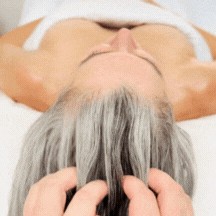
This is why scalp and neck work often creates immediate softening in the face.
You’re not just working locally. You’re influencing the fascial chain.
Why This Changes Everything
Facial tension isn’t random.It’s adaptive.It’s intelligent.
The face reflects what the body is holding.
This is why at FACE FORM in Franklin, TN, our buccal massage approach looks beyond the face alone. We work with the jaw, neck, and surrounding fascial systems to support real relief and long-term change.

This is the difference between:
temporary improvement
and lasting transformation
Experience Buccal Massage in Franklin, Tennessee
If you’re noticing jaw tension, facial stiffness, asymmetry, or aging that doesn’t respond to surface-level treatments, your body may be asking for a deeper approach.
✨ Book your buccal massage session at FACE FORM in Franklin, TN and experience facial work that respects how your body is truly connected.


Comments